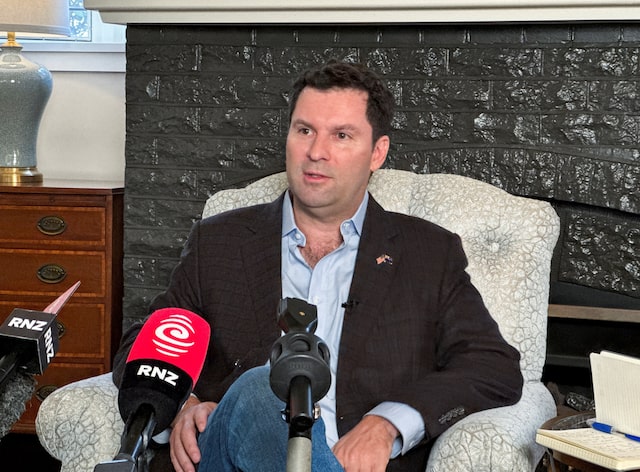
WELLINGTON, July 3 (Reuters) – The new U.S. ambassador to New Zealand and several Pacific island nations said on Friday that securing Cook Islands seabed minerals was a top priority, and that China’s push for influence in the Pacific carried risks for small island states.
Jared Novelly, U.S. ambassador to New Zealand, the Cook Islands, Niue and Samoa, said in a press conference that critical minerals had moved rapidly up his agenda over the last year.
“When I was getting briefings in October, November last year, the critical minerals thing was kind of a lesser item,” Novelly said. “Fast forward to February, March of this year, critical minerals, and particularly in the Cooks, is either 1A or 1B of my priorities.”
Washington has made securing critical minerals a strategic priority as it seeks to reduce its reliance on China-dominated supply chains and support defence and clean-energy industries.
The Cook Islands’ waters contain deposits of polymetallic nodules, sought for batteries and other technologies, and the government has allowed exploration, but not commercial extraction. In February, the Cook Islands and the U.S. signed a non-binding framework on critical minerals research and supply-chain security, including deep-sea minerals in Cook Islands waters. It has also signed an exploration and research agreement with China.
Novelly, a Missouri businessman and sports team owner who is the inaugural U.S. ambassador to the Cook Islands, said he planned to spend time in the country and would look to introduce U.S. companies that could help with the minerals’ extraction.
The Cook Islands government did not immediately respond to a request for comment.
He said he also believed he needed to warn Pacific countries to be cautious in dealings with Beijing.
“China has made no bones about they want a base in the Pacific, they want an expanded presence there,” he said, adding that island nations needed to understand “what a debt trap is” and that “there can be strings attached”.
China in recent years has become a major player in the region, in development finance, ports, airports and telecommunications, and has sought a greater role in the military, policing, digital connectivity and media. Beijing says its relationships in the region are based on mutual respect and delivering benefits to the Pacific people.
Novelly said he was also exploring ways to support Pacific economies beyond aid, including by reducing the cost of remittances.
U.S. FACES MORE SCEPTICAL KIWIS
Novelly arrived in New Zealand earlier this week and presented his credentials to the governor general on Wednesday before hosting the embassy’s annual July 4 party.
Novelly said Washington respected New Zealand’s role in the South Pacific, including defence cooperation, but said partners needed to spend more on security.
“It’s important that you care as much about your defence as we care about your defence,” he said, echoing U.S. policy towards partners and allies around the globe.
Novelly arrives as New Zealanders’ views of the United States have fallen. A June survey by the Asia New Zealand Foundation found that, for the first time in a decade, they viewed Washington as more of a threat than China.
But Novelly said it was not something he had experienced on his visits to the country and “there seems to be a very friendly camaraderie that occurs between folks from the U.S. and Kiwis.”
On New Zealand’s nuclear-free policy, which restricts visits by nuclear-powered or nuclear-armed vessels, Novelly said any change was a decision for Wellington but that he would like to see a U.S. aircraft carrier visit in Auckland harbour.
“I would really like the opportunity to work with New Zealand on that,” he said.
Reporting by Lucy Craymer; Editing by Kate Mayberry.