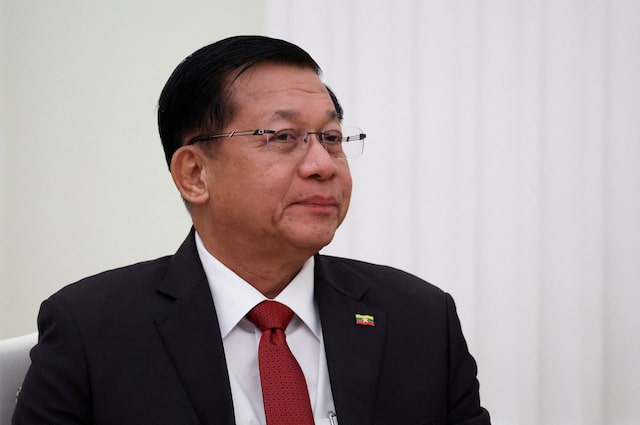
July 1 (Reuters) – Myanmar junta chief turned president Min Aung Hlaing will make an official visit to Laos in the next few days, state media reported on Wednesday, his first trip to an ASEAN member state since taking on his new civilian role.
The planned trip comes four months after Min Aung Hlaing completed a carefully engineered transition from head of the military government to president. He has already visited Myanmar’s giant neighbours, India and China.
At the invitation of Lao President Thongloun Sisoulith, Min Aung Hlaing will travel with his spouse and a delegation of senior cabinet ministers and officials, the state-run Global New Light of Myanmar newspaper reported.
It did not specify the dates of the visit.
The 11-member Association of Southeast Asian Nations (ASEAN) did not endorse the results of Myanmar’s three-stage polls in December and January, which excluded major opposition groups and ended in an overwhelming victory for a party backed by the military.
But ASEAN leaders have sought to engage more with Myanmar since the election, with Malaysian foreign minister Mohamad Hasan and Thailand’s top diplomat Sihasak Phuangketkeow making trips to the capital Naypyitaw.
Min Aung Hlaing took power in a 2021 coup against an elected government led by Aung San Suu Kyi, which triggered protests that subsequently morphed into a devastating civil war that continues to rage.
Shortly after the coup, ASEAN unsuccessfully pushed its own peace plan for Myanmar known as the “five-point consensus”. It also barred Myanmar’s ruling generals from their summits, with Min Aung Hlaing mostly isolated diplomatically until last year.
After his election victory, Min Aung Hlaing said that restoring ties with ASEAN was one of his government’s main priorities.
“A state visit to Laos represents the clearest break yet with the diplomatic quarantine that ASEAN imposed on Naypyitaw after the coup,” said Richard Horsey, senior Asia advisor at the International Crisis Group.
“That inevitably weakens the political force of the five-point consensus, and means that the shrinking number of ASEAN states still arguing against normalisation will find it increasingly difficult to hold the line,” he said.
Reporting by Reuters staff; Editing by David Stanway.