
NEW YORK, June 19 (Reuters) – Should I open a Trump Account, even if my child isn’t eligible for the free money?
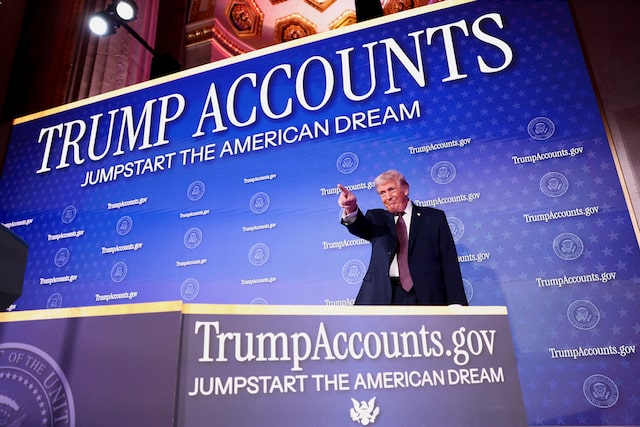
With the official launch of federal Trump Accounts slated for July 4, plenty of parents are asking me if they should utilize this new tax-deferred investment vehicle — especially if their children fall outside the 2025 to 2028 birth window that qualifies for a one-time $1,000 seed contribution from the U.S. government.
Nearly three-quarters of parents surveyed by Babylist, a baby registry company, say they are likely to open a Trump Account or have already claimed an account.
But the public’s understanding is scarce. More than half of parents say they “only know a little” about how Trump Accounts work, Babylist says.
Even without that initial federal “free money” or potential matching funds from private citizens and employers, eight out of the 10 experts I spoke to said that Trump Accounts (officially known as 530A accounts) offer a compelling savings option, yet they must be carefully weighed against existing investment alternatives like 529 Plans, and other types of gift accounts.
Here are three things to consider when saving for a child’s future.
WHAT ARE THE LIMITS AND RULES?
The rules are straightforward: you can contribute up to $5,000 a year per child in a Trump Account. If your kid qualifies for the initial $1,000 federal seed, that’s an extra bonus on top.
“If your child is eligible for the $1,000 contribution by the U.S. government or they are one of the 25 million children who are in the tax areas that qualify for the Michael and Susan Dell Grant of $250, then do it,” says Monica Dwyer, senior vice president at Harvest Financial Advisors in West Chester, Ohio. “If your employer is offering a contribution as a benefit to your child, then yes, it is a no-brainer.”
Employers can chip in too, up to $2,500 a year, although that does count toward your overall $5,000 annual cap.
Once the money is in a Trump Account, it will be invested in low-cost index funds. Your account grows tax-deferred, and it’s only taxed when it gets withdrawn down the road. Families should not plan on tapping these funds before age 18, when the account converts into a Traditional IRA. Compare that to a 529 college savings plan, where you can stash hundreds of thousands of dollars for tuition and other education-related expenses tax-free, depending on your state. Plus, 529s offer a wide menu of investment options to select.
“Every family has to ask themselves the same basic questions here,” says Patrick Huey, a certified financial planner as well as the owner of Victory Independent Planning, with offices in Naples, Florida, and Portland, Oregon. “What is the tax treatment? What are the withdrawal rules? Who actually controls the account, and when? And what happens if your child’s path looks completely different than you imagined?”
Because they are so new, there are other unanswered questions about Trump Accounts. “We need to see how these accounts are treated for financial aid purposes…and whether they could affect eligibility for other benefits,” notes Joe Piszczor, a certified financial planner and founder of Washington Family Wealth in Washington, Pennsylvania.
RETIREMENT VS. COLLEGE VS. EVERYTHING ELSE
While Trump Accounts are being marketed as a head start for retirement, they can be used for education, housing or other adult expenses.
That said, if you’re pretty certain a child is headed to college, a 529 plan is my preferred savings tool. In addition to our kids, I have opened accounts for my nieces and nephews, and I fund them all quarterly with $50 contributions. My nephew Noah, who is 23 and in a five-year college program, has almost $8,400 in his 529 account. I’m planning to contribute it to his next tuition bill.
However, as Huey points out, it’s tough to predict the future when a kid is still in diapers. “Most parents with toddlers aren’t trying to guess at age two whether their kid will want a four-year degree, trade school, a business startup or just a solid financial cushion to kick off adulthood,” Huey says.
It’s important to note that money stashed in a 529 has alternative uses. You can transfer unused funds to another family member. And a newer twist with 529 plans is that you can actually roll leftover money you don’t use for college straight into a Roth retirement account.
THE BEST WAY TO SAVE IS TO START
When it comes to funding a child’s future, the structure of the savings vehicle is secondary to the act of saving itself, thanks to the power of compounding.
“Time is the most important tool someone has,” explains Andrew Herzog, an associate wealth advisor at The Watchman Group in Plano, Texas, who set up Trump Accounts for his three young kids. “Compounding is not linear – early dollars can carry disproportionate weight because they have the most time to work.”
If you make a $1,000 deposit in a Trump Account and leave it alone, the money could grow to $3,513 by the time the child turns 18, assuming a 7% annualized rate of return, according to Babylist’s calculator. If that same money is left in the account until retirement at age 65, it could grow to $94,000. (It’s worth checking out Babylist’s on Trump Accounts for more detailed information.)
“My view is fairly simple: if you qualify for the free government contribution, it is hard to argue against taking it,” Huey says.
And, if your child is not eligible for the seed money, the account can still make sense if you value flexibility and long-term compounding. “In many households, that may make it the first dollars saved for a child,” Huey notes.
I know this is wonky stuff. If you have additional questions about saving for your children’s future or anything else related to your money, please reach out to me via the link in my bio.
by Lauren Young.