

Building an Inclusive Social Security Ecosystem
Posted On: 25 AUG 2026 2:38PM by PIB Delhi
| The e-Shram Portal completes five years on 26 August 2026, marking a significant milestone in strengthening social security for India’s unorganised workforce. Launched in 2021 by the Ministry of Labour and Employment, it created the country’s first-ever Aadhaar-seeded National Database of Unorganised Workers. It gives every registered worker a unique Universal Account Number and has evolved into a one-stop digital platform integrating welfare, jobs, skilling, apprenticeship and pension services. With over 31.89 crore registrations, e-Shram has improved benefit delivery, portability and evidence-based policymaking. It advances the Government’s vision of an inclusive, technology-driven social security ecosystem. |
Empowering India’s Unorganised Workforce
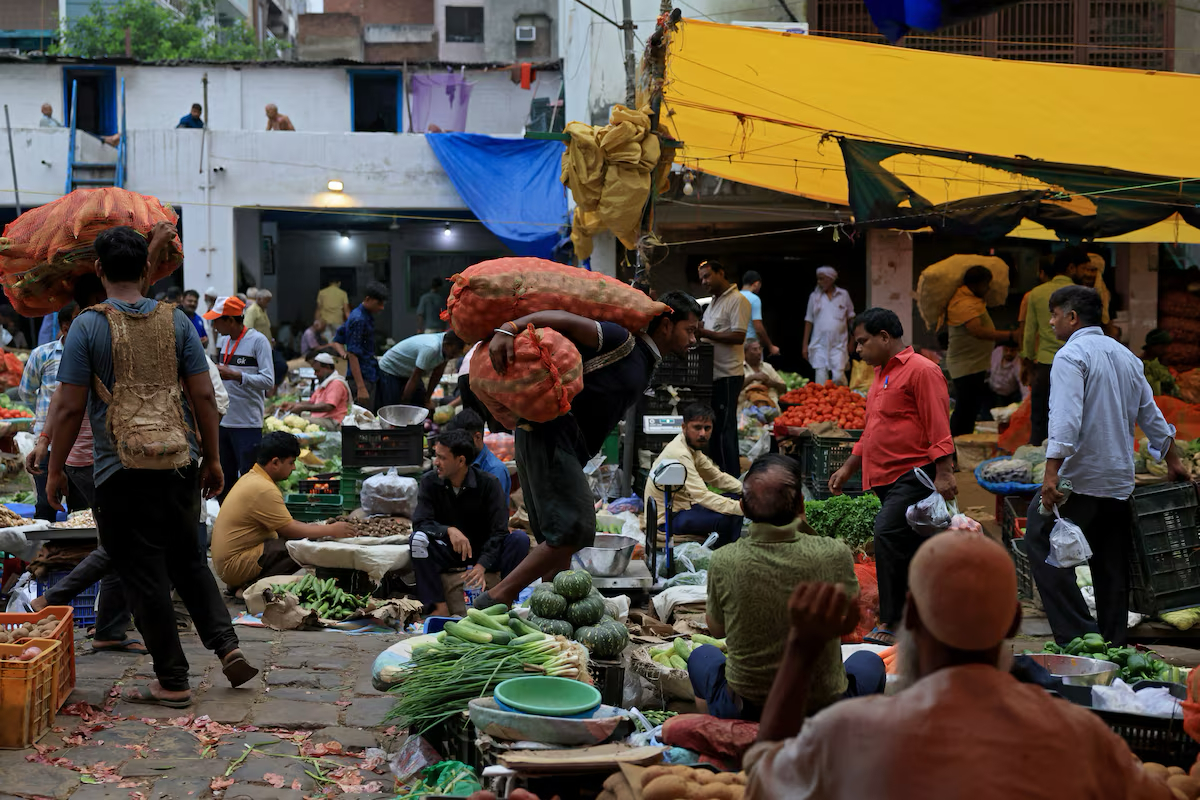
As India advances towards the vision of Viksit Bharat, empowering its vast workforce remains central to inclusive and sustainable growth. The unorganised sector comprises a diverse range of workers, including agricultural labourers, construction workers, domestic workers, street vendors, migrant workers, gig and platform workers, and many others. Together, they form a vital pillar of India’s workforce and economy. Ensuring their access to social security and welfare has therefore remained a key priority of the Government.
Building on this commitment, the e-Shram Portal was launched on 26 August 2021, and completes 5 years since then. It marks an important milestone in India’s efforts to build a comprehensive social security ecosystem for unorganised workers.

The Vision Behind e-Shram
The e-Shram Portal, developed by the National Informatics Centre (NIC), created the country’s first Aadhaar authenticated National Database of Unorganised Workers (NDUW).It provides every registered worker with a unique 12-digit Universal Account Number (UAN). The key objectives include:
- Improve delivery of social security services by enabling the convergence of welfare schemes across Ministries and Departments.
- Facilitate secure sharing of worker data with government agencies through APIs. This supports the effective delivery of welfare schemes and evidence-based policymaking.
- Facilitate nationwide access and portability of social security and welfare benefits for migrant and construction workers.
- Create a comprehensive national database that supports timely planning and response during national emergencies and crises.
| “Unorganised worker” includes a home-based worker, self-employed worker, or a wage worker in the unorganised sector. It also includes a worker in the organised sector who is not a member of ESIC/ EPFO/ Government Employee. |
Evolution into a One-Stop Solution
The e-Shram portal transformed from a worker registry into a unified service delivery platform with the launch of the e-Shram One-Stop Solution on 21 October 2024. It now integrates welfare, employment, skilling and pension services. This aligns with the Union Budget 2024–25 vision of delivering a wide range of labour services through a single digital platform. Registered workers can access eligible schemes and view benefits already received. The platform also promotes convergence across government portals. It strengthens access to social security and improves service delivery for unorganised workers.
- The One-Stop Solution brings together 15 Social Security and Welfare Schemes on a single platform. These include Pradhan Mantri Shram Yogi Maan-Dhan Yojana (PM-SYM), Pradhan Mantri Suraksha Bima Yojana (PMSBY), Pradhan Mantri Jeevan Jyoti Bima Yojana (PMJJBY), National Social Assistance Programme (NSAP), One Nation One Ration Card (ONORC), Pradhan Mantri Awaas Yojana–Gramin (PMAY-G) and others.
- eShram registrants can conveniently enrol in the Pradhan Mantri Suraksha Bima Yojana (PMSBY) and Pradhan Mantri Jeevan Jyoti Bima Yojana (PMJJBY) through the eShram portal. Under PMSBY, workers are eligible for accidental insurance benefits of ₹2 lakh for accidental death or permanent disability and ₹1 lakh for partial disability. PMJJBY provides a life insurance cover of ₹2 lakh in the event of death due to any cause.
- The portal connects workers with the National Career Service (NCS) for employment opportunities. It also provides access to the Skill India Digital Hub for skilling and apprenticeship. Workers can also use myScheme to identify government schemes for which they may be eligible.
- Through the portal, eligible workers can enrol in the Pradhan Mantri Shram Yogi Maan-Dhan (PM-SYM) Scheme, which offers a minimum assured pension of ₹3,000 per month upon attaining the age of 60 years, subject to eligibility.
- Powered by the Bhashini platform, multilingual functionality in 22 languages was introduced in 2025.
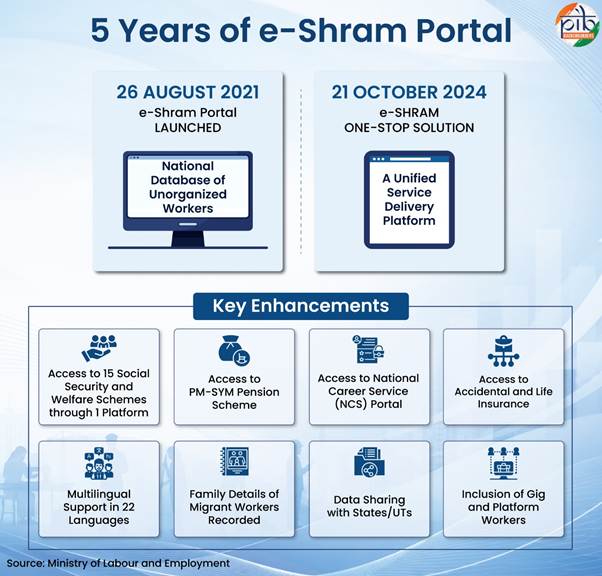
- The portal includes a provision to capture the family details of migrant workers.
- It enables sharing of construction workers’ data with States and Union Territories. This facilitates their registration with the respective Building and Other Construction Workers (BOCW) Boards.
- eShram provides a platform for the identification and registration of gig and platform workers as part of the national database of unorganised workers. As of date, around 11.5 lakh platform workers have registered on the portal. This database may support the formulation and implementation of suitable social security and welfare measures for such workers.
e-Shram Registration: Eligibility and Process
Registration on the e-Shram Portal is simple, accessible and a one-time process.
Eligibility: Any worker aged 16 years and above, engaged in the unorganised sector, is eligible to register on the e-Shram Portal. A worker must not be an income tax-payer or a member of the Employees’ Provident Fund Organisation (EPFO) or the Employees’ State Insurance Corporation (ESIC).
Coverage: The portal covers a wide range of unorganised workers. These include construction workers, migrant workers, gig and platform workers, street vendors, domestic workers, agricultural workers, and other unorganised workers.
How to register: Workers can register by visiting the e-Shram Portal (https://register.eshram.gov.in/#/user/self). They can also register through the nearest Common Service Centre (CSC) or State Seva Kendra. State Government field officers also facilitate registration at the district and sub-district levels.
Registration cost: Registration on the e-Shram Portal is completely free of cost. Workers are not required to pay any fee to any registering agency or service provider.
Required Documents: Registration requires their Aadhaar number (for Aadhar eKYC) and a mobile number (preferably linked with Aadhaar).
Growing Coverage of India’s Unorganised Workforce
Registrations on e-Shram portal over the past 5 years reflects broad participation across genders, age groups, occupations and States (as on 18 August, 2026).
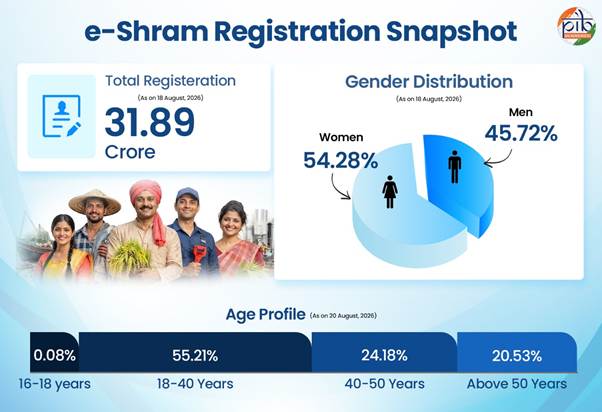
- Total registrations: The portal has recorded 31.89 crore registrations.
- Gender distribution: Women account for 54.28% of registered workers, while men account for 45.72%.
- Age profile: 0.08% are aged 16-18 years, 55.21% of registered workers are aged 18–40 years, 24.18%are aged 40–50 years and 20.53% are above 50 years (as on 20 August, 2026).
- Top occupational categories: Agriculture, Domestic and Household Workers, Construction, and Apparel account for the highest registrations.
- Top States: Uttar Pradesh, Bihar, West Bengal, Madhya Pradesh, and Maharashtra have recorded the highest registrations.
- Mode of registration: Most registrations have been completed through Common Service Centres (CSCs), followed by self-registration.
Building the Future of Labour Welfare
The e-Shram Portal has laid a strong foundation for an inclusive and technology-enabled social security ecosystem for India’s unorganised workforce. By creating a nationwide digital identity and database for unorganised workers, it has enabled more targeted and transparent delivery of government support. As its coverage and services continue to expand, e-Shram remains an important digital pillar of a more inclusive and future-ready workforce.