
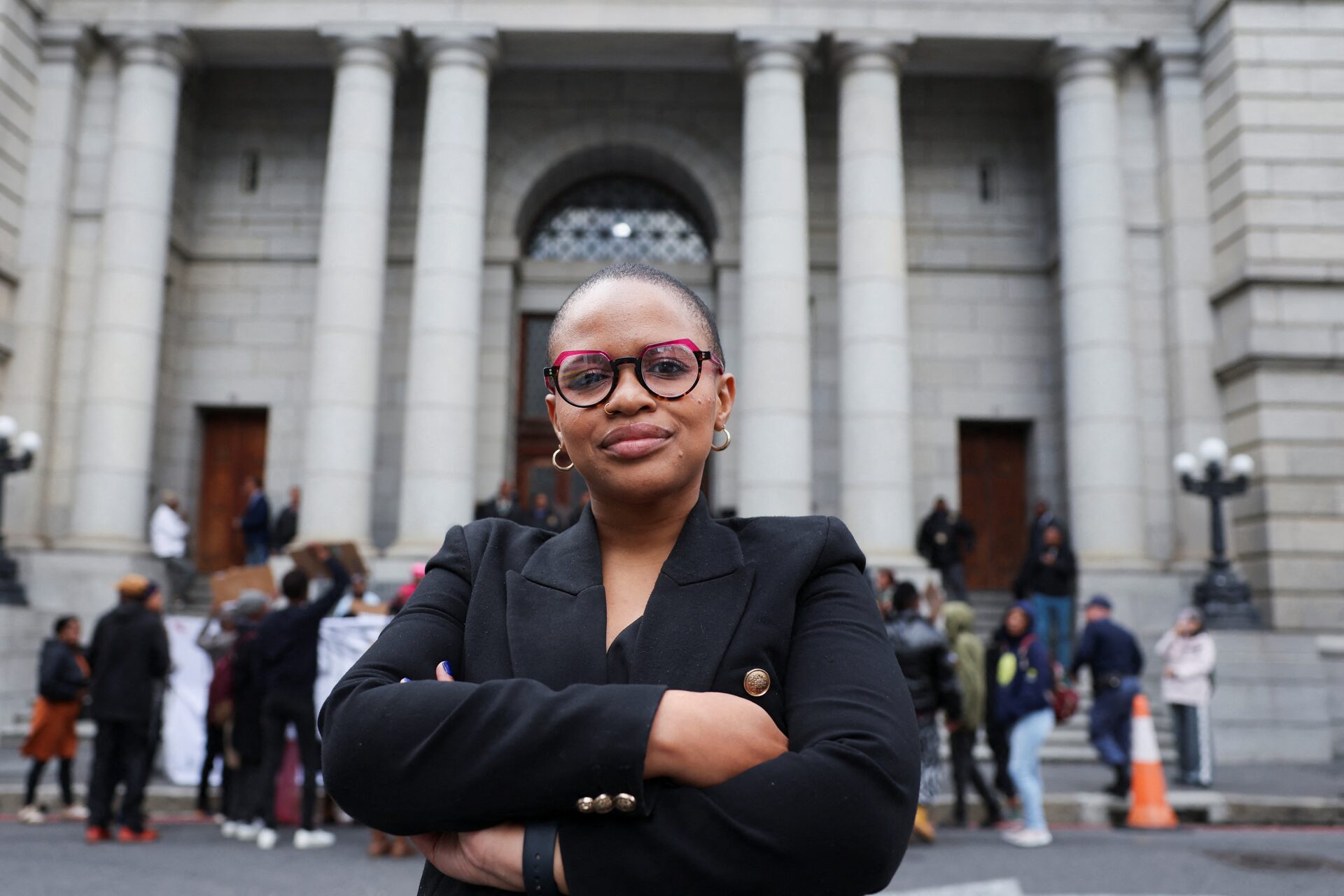
Inga Dyantyi, a black lawyer who is suing her former employer for discrimination, poses for a photograph outside the High Court, in Cape Town, South Africa, April 22, 2026. REUTERS
JOHANNESBURG, May 4 (Reuters) – Four of South Africa’s top law firms are suing the government over new Black employment and ownership targets aimed at undoing decades of racial injustice, calling them “irrational” and saying the timeline is unrealistic given the expertise required.
The case comes amid scrutiny of affirmative action policies – which aim to tackle the disadvantages that white-minority rule inflicted on the country’s non-white majority – partly fuelled by criticism from U.S. President Donald Trump and South African‑born billionaire Elon Musk.
Underlying the court action – which aims to force the government to scrap the new targets – are tensions between some Black lawyers and the companies.
Ex-employees at two of the four have brought discrimination cases against them which the firms intend to defend. The firms declined to comment on individual suits.
The legal profession, like much of corporate South Africa, remains largely white three decades after the end of apartheid. White people make up about 7% of the population, and 72% of partners at top law firms, according to the industry regulator.
In late 2024, the government introduced a new code for the legal sector under a policy known as Broad-based Black Economic Empowerment (B-BBEE), setting a target of 50% Black ownership of large firms within five years, with 25% Black women.
The challenge to that code brought by the law firms – Deneys (formerly Norton Rose Fulbright South Africa), Webber Wentzel, Werksmans and Bowmans – will be heard in Pretoria’s High Court on Monday.
SOME BLACK LAWYERS ALLEGE DISCRIMINATION
Reuters spoke with 13 current and former employees of Deneys, Webber Wentzel and Bowmans for this story; it was unable to reach anyone from Werksmans.
All described either subtle or explicit discrimination which they said made it harder for Black people to advance and caused many to leave out of frustration.
They said this included apparent favouritism in the allocation of case work, getting passed over for promotions they felt they merited at least as much as white colleagues and, in one case, refusing reduced hours for a new Black mother that were granted to a white mother in a similar situation.
Reuters could not independently verify their accounts.
Deneys declined to comment on allegations, while Webber Wentzel and Bowmans said they do not tolerate discrimination and that they have processes for addressing complaints.
“It’s so obvious – the racism – it’s all palpable (but) silent,” said Inga Dyantyi, 30, who left Deneys in 2024 and has accused the firm of racial discrimination in a pending case at the Labour Court.
Deneys has denied her claims in court papers seen by Reuters.
Dyantyi specifically accused a director of making demeaning remarks about her, and claimed that the firm made her continued employment so intolerable that she had to resign.
Another Black lawyer has a pending discrimination case at the Labour Court against Webber Wentzel, which she also accused of making her employment intolerable. She declined to be named out of fear it would hurt her job prospects.
Webber Wentzel has filed a notice of intention to defend which was seen by Reuters.
Two other Black women said they had brought complaints of unfair treatment against Deneys and Webber Wentzel to the Commission for Conciliation, Mediation and Arbitration (CCMA), a first step in workplace disputes.
One case was dismissed on procedural grounds and the lawyer resigned, while the other ended in a settlement.
FIRMS SAY TIMELINE TOO TIGHT
The Legal Sector Code is not strictly mandatory but compliance is required to do business with the government, which is the country’s largest consumer of legal services.
All four firms opposing the code were compliant with the previous B-BBEE rules, which remain in effect for many sectors and set a lower threshold of just over 25% Black ownership.
In a joint statement, Webber Wentzel said it had increased the share of Black partners from 25% in 2019 to 38% in 2026, Werksmans said it had increased Black partners from 20% to 31% in the same period, and Bowmans said it had maintained Black ownership between 25% and 29% over the last decade.
Deneys declined to share figures.
The firms have argued they cannot reach 50% within five years because the path to equity partnership takes longer and must be merit-based. They also object to other parts of the code, which changes various aspects of the scorecard system used to measure B-BBEE compliance.
“We want to be part of the solution. But it must be one that is legally sound, practically workable, and which genuinely advances black participation in the profession,” Deneys said.
The other firms said that the current target “risks forcing outcomes that are neither sustainable nor lawful”.
South Africa’s Justice Minister Mmamoloko Kubayi has pledged to defend the sector code, saying it is something the state is “not willing to bend” on.
BLACK LAWYERS LEAVE BEFORE REACHING SENIOR LEVEL
While firms are diverse at entry level, statistics show a high attrition rate for Black lawyers.
The Johannesburg Society of Advocates, the country’s largest bar, found that two thirds of the 406 junior advocates who left the bar over the past five years were Black.
Figures from the Legal Practice Council in 2024 showed that while the top six firms, which include the complainants, were 59% Black at associate level, that dropped to a quarter at partner level.
“The only conclusion we can reach is that there is a ceiling that these firms believe Black people should have,” said Christine Qunta, chairperson of the Legal Sector Charter Council, which enforces the code.
“It means that the kind of problems we faced at the dawn of democracy in 1994, the current and next generation will face. We cannot allow that,” she said.
Reporting by Nellie Peyton; Editing by Tim Cocks, Mike Collett-White and Andrew Heavens