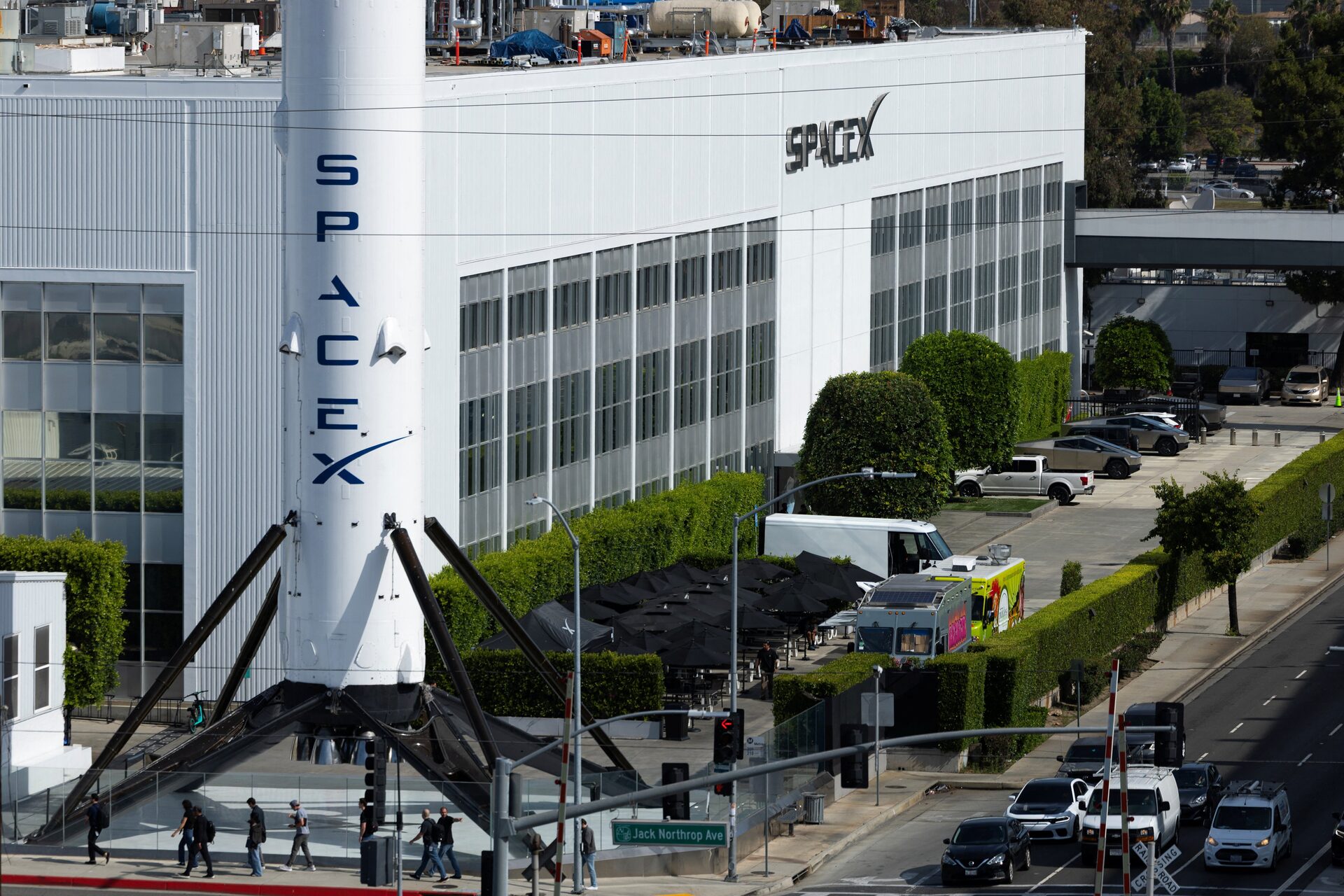
The SpaceX facility and a Falcon 9 rocket booster are shown, as the company prepares to file for an initial public offering (IPO), in Hawthorne California, U.S., April 23, 2026. REUTERS
NEW YORK, (Reuters) – Elon Musk’s SpaceX took out a $20 billion bridge loan last month to refinance much of its existing debt ahead of its blockbuster U.S. initial public offering, according to a regulatory filing.
The borrowing, revealed for the first time in excerpts of its regulatory filings that were reviewed by Reuters, came from a syndicate of lenders which were not identified. Under the terms of the loan, SpaceX could be forced to use proceeds from its IPO to repay it, if it is not repaid with other funding sources within six months of the offering.
SpaceX did not respond to a request for comment.
SpaceX is expected to be the largest IPO in history when it lists this summer. The rocket and artificial intelligence conglomerate is expected to garner a valuation in the range of $1.75 trillion, Reuters previously reported.
The information was contained in an S-1 document, which companies preparing to go public file with the U.S. Securities and Exchange Commission to disclose details about their business and finances to potential investors. Reuters reviewed an excerpt of the SpaceX S-1, which was filed confidentially.
The bridge loan replaced five existing debt facilities, of which two were term loans tied to Musk’s X social media platform and three borrowings by xAI, the billionaire’s artificial intelligence business. The new loan helped to reduce SpaceX’s total debt to $20.07 billion as of March 2, compared with $22.05 billion at the end of 2024, the filing added.
Bridge loans are common financing tools with relatively short lifespans and are often refinanced at a later time with new, longer-term debt. The SpaceX bridge loan runs for 18 months, with the possibility of two three-month extensions.
Companies often choose them around a major event, such as a merger or large acquisition, especially if that move is expected to be beneficial for the company and will ultimately lower its borrowing costs.
Reporting by Echo Wang and David French in New York; Editing by Edmund Klamann