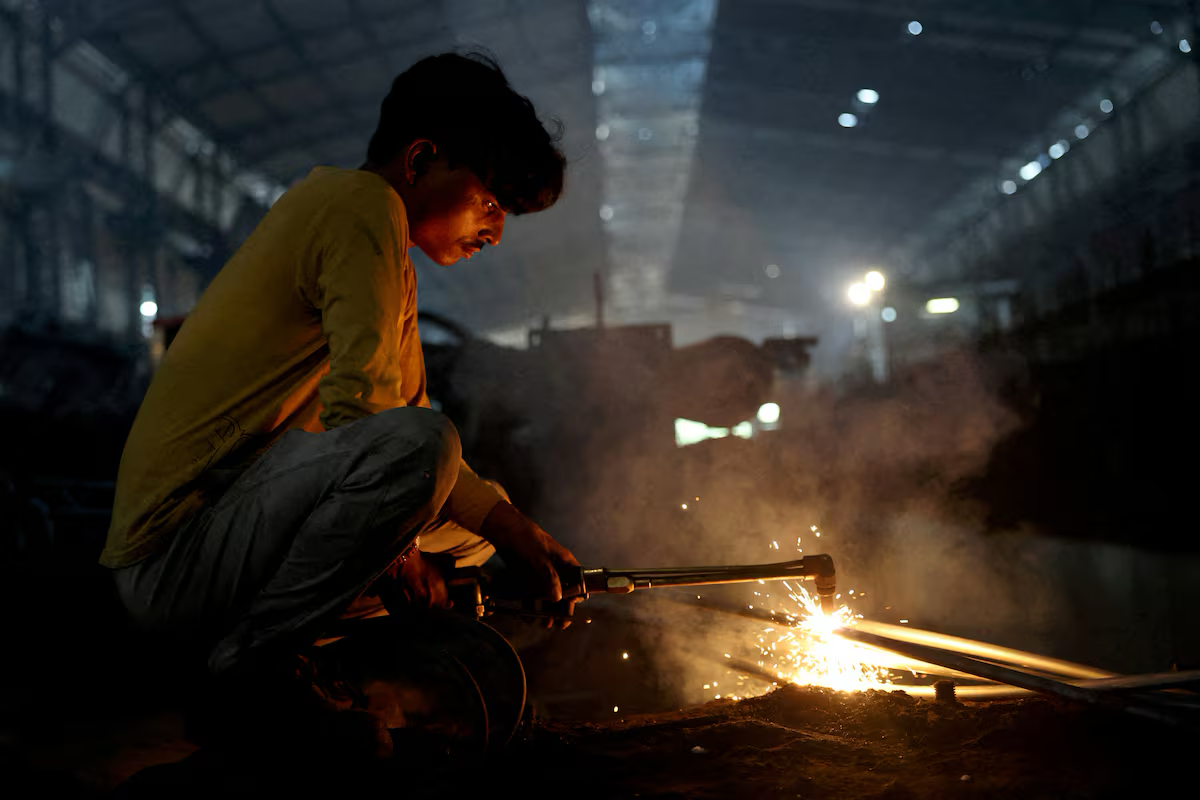
A worker welds a steel bar at a steel processing production line of a factory in Mandi Gobindgarh, in the northern state of Punjab, India, August 14, 2025. REUTERS
BENGALURU, April 2 (Reuters) – India’s manufacturing sector grew at its slowest pace in nearly four years in March as the war in the Middle East stoked uncertainty, disrupted supply chains and dented demand, while higher oil prices drove up input costs, a private survey showed.
Here are the key details:
-
The HSBC India Manufacturing Purchasing Managers’ Index (PMI) compiled by S&P Global, fell to 53.9 in March from 56.9 in February, broadly in line with a preliminary estimate of 53.8.
-
New orders – a key gauge for demand – and output expanded at their weakest rate in close to four years.
-
“Disruptions linked to the conflict in the Middle East are reverberating through the global economy and weighing on Indian manufacturers,” said Pranjul Bhandari, chief India economist at HSBC.
-
Export orders surged to a six-month high in March.
-
Firms faced their steepest cost pressures since August 2022, with prices for aluminium, chemicals, fuel and steel all rising sharply.
-
Despite the surge in input costs, companies raised selling prices at the slowest pace in two years.
-
Employment growth stayed solid in March with the pace hitting a seven-month high as firms added staff to clear backlogs and support expansion plans.
-
Manufacturers remained optimistic about the year ahead with sentiment reaching its highest since May 2024 on expectations of agricultural strength and capacity expansion.
Reporting by Shaloo Shrivastava; Editing by Shri Navaratnam