


Table of Contents
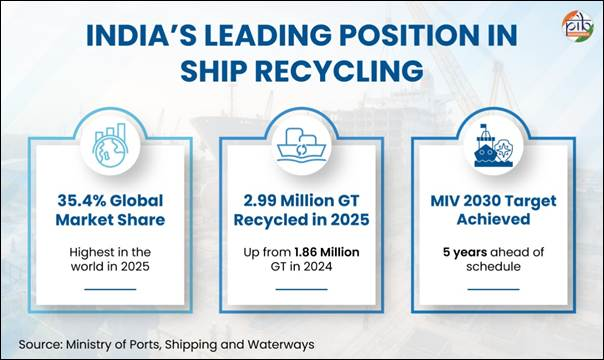
| India’s ship recycling sector has evolved into a modern and internationally aligned industry. In 2025, India became the world’s leading ship recycling nation. Its global market share increased from 30.1% in 2024 to 35.4% in 2025. Ship recycling volume also rose from 1.86 million gross tons to 2.99 million gross tons. This represents nearly 60% growth in recycling volume. The Alang-Sosiya cluster remains the backbone of India’s recycling capacity. Comprehensive legislation, alignment with the Hong Kong International Convention, and yard modernisation have strengthened safety, compliance, and competitiveness. |
The Evolving Maritime Industrial Landscape
A strong maritime ecosystem extends beyond shipbuilding and port operations. It also requires responsible management of ships at the end of their service. Ship recycling is an integral part of the maritime lifecycle. It enables the safe, environmentally sound and resource-efficient dismantling of ships at the end of their operational life. When undertaken under a robust regulatory framework, it supports circular economy objectives through the recovery of steel and other reusable materials. It also safeguards the environment while ensuring the health and safety of workers.
Stronger legislation and enhanced institutional oversight have driven the transition from conventional dismantling practices into an internationally aligned industry. Compliance, sustainability and worker safety are now central to its operations. These reforms have strengthened India’s global standing. Today, India has emerged as a leading destination for environmentally sound ship recycling.
Why Ship Recycling Matters?

Ship recycling is strategically important for India’s resource security, economic growth, and environmental sustainability.
Environmental Significance
- Regulated ship recycling prevents unsafe disposal of end-of-life ships. It reduces the risk of marine and coastal pollution.
- Proper recycling practices ensure the safe handling of hazardous materials under strict regulatory supervision.
Resource Significance
- Ship recycling provides a significant source of ferrous scrap for the domestic steel industry. It reduces dependence on imported raw materials and strengthens supply security.
- The recovery and reuse of steel supports efficient resource utilisation and promotes a circular economy.
- Recycled steel requires substantially less energy than primary steel production. It also results in lower greenhouse gas emissions, supporting India’s sustainability and decarbonisation objectives.
Economic and Industrial Significance
- The ship recycling sector generates large-scale employment. It supports the livelihoods of workers involved in dismantling, processing, and material recovery activities.
- It sustains a wide network of ancillary industries. These include transport, re-rolling mills, equipment suppliers, and waste management services.
- Recovered steel and reusable components support domestic manufacturing and industrial production. This aligns with national initiatives such as Make in India and Atmanirbhar Bharat.
India at the Forefront
India’s ship recycling sector has witnessed sustained growth in recent years. According to the latest report of the United Nations Conference on Trade and Development (UNCTAD), India ranked first globally in ship recycling in 2025. India’s share of global ship recycling increased from 30.1% in 2024 to 35.4% in 2025. This marks a significant milestone in the country’s maritime and industrial development.
Ship recycling volume in India also increased from 1.86 million Gross Tonnes (GT) in 2024 to 2.99 million GT in 2025. This represents nearly 60% growth in recycling volume. The rise reflects India’s expanding capacity and indicates the growing competitiveness of Indian ship recycling yards in the global market. The target set under Maritime India Vision (MIV) 2030 to become the world’s leading ship recycling nation has been achieved five years ahead of schedule.
Alang-Sosiya: Powering India’s Ship Recycling Sector
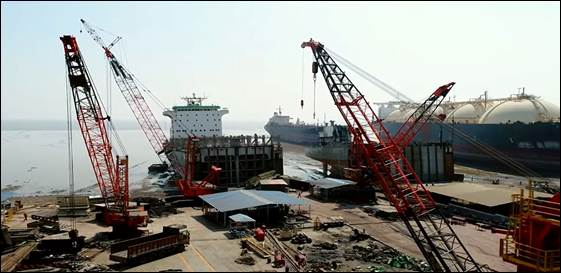
The Alang-Sosiya ship recycling cluster in Gujarat forms the backbone of India’s recycling capacity. It is recognised as the world’s largest ship recycling hub. The cluster accounts for approximately 98% of India’s ship recycling activity. It has an annual recycling capacity of around 6 million GT. Around 3.50 million metric tonnes (MMT) of steel is produced per annum at Alang without exploiting natural resources. It is supported by authorised ship recycling yards, downstream steel re-rolling mills, and waste management infrastructure. Over the years, the cluster has undergone extensive modernisation and represents India’s primary interface with the global ship recycling market.
India aims to nearly double its ship recycling capacity to about 9 million light displacement tons (LDT). This expansion will be achieved through the planned development of the Alang Ship Recycling Yard. A comprehensive master plan has been prepared to support future demand. The plan focuses on improving infrastructure and strengthening India’s competitiveness in the ship recycling market.
The Safety Training and Labour Welfare Institute at the Alang-Sosiya ship recycling yard has trained over 1.5 lakh workers cumulatively. The training covers occupational safety, hazardous material handling and emergency response. In addition to this, India has a ship recycling yard at Amar Iron Udyog in Kolkata and another at Steel Industrials Kerala Limited (SILK) in Kerala.
Alang-Sosiya Ship Recycling Yard
Indian ship recycling yards have undergone major upgradation in recent years. They now operate with the following facilities and arrangements:
- Engineered and demarcated recycling plots.
- Impermeable working surfaces and drainage systems.
- Mechanised material handling and lifting equipment.
- Segregated hazardous waste storage areas.
- Authorised downstream waste treatment and disposal linkages.
- Structured safety, health, and emergency response arrangements.
These improvements have strengthened the safety, environmental compliance, and operational efficiency of Indian ship recycling yards.
Regulatory and Compliance Framework
India has established a comprehensive statutory and regulatory framework for ship recycling activities. The framework is aligned with international conventions and recognised global best practices. It regulates the entire ship recycling lifecycle. This includes ship preparation, certification, yard authorisation, operations, and compliance monitoring.
Legal and Institutional Architecture
- Ship Recycling Act, 2019: The Act provides the primary legal framework for regulating ship recycling in India. It gives domestic effect to international standards. It also designates the Directorate General of Shipping as the National Authority. The Act mandates authorisation, certification, inspection, and enforcement mechanisms.
- Ship Recycling Rules, 2021: The Rules operationalise the Act by prescribing procedural and technical requirements. These include facility authorisation, ship recycling plans, hazardous material management, worker safety, training, and reporting obligations.
- Ship Recycling Regulations, 2026: The Regulations strengthen implementation through detailed operational, safety, and environmental standards. They support uniform compliance and effective monitoring across ship recycling facilities.
Together, the Act, Rules, and Regulations establish a structured and enforceable regulatory framework for ship recycling in India. The framework also aligns domestic practices with internationally accepted standards.
Alignment with the Hong Kong International Convention (HKC)
The Hong Kong International Convention for the Safe and Environmentally Sound Recycling of Ships is the principal international instrument governing ship recycling. It lays down legally binding requirements for ships and recycling facilities. The Convention came into force on 26 June 2025. From this date, compliance became mandatory. India has aligned its domestic framework through the Ship Recycling Act, Rules, and Regulations. Financial assistance of ₹53.5 crore has been provided for the modernisation of ship recycling yards. This support has helped 115 facilities achieve compliance with the Hong Kong Convention.
35 ship recycling yards at Alang, Gujarat, have applied for EU green-listing, and the EU side has initiated the inspection process of Indian yards. Shree Ram Vessel Scrap and Y. S. Investments have been included in the draft of the 16th European List of Ship Recycling Facilities.
Ensuring Safe Recycling through IHM
The Inventory of Hazardous Materials (IHM) forms a key element of safe ship recycling. It identifies and records hazardous substances present on board ships throughout their operational life and before recycling. India follows a lifecycle-based compliance approach. This ensures transparency, traceability, and effective risk mitigation before ships enter authorised recycling facilities.
Ship-breaking Credit Note Scheme
The Ship-breaking Credit Note Scheme, introduced under the Ship Building Financial Assistance Scheme (SBFA) 2.0, encourages shipowners to recycle vessels at compliant Indian ship recycling yards. It also promotes the construction of new vessels at Indian shipyards. This scheme incentivizes ship scrapping by issuing a Credit Note equivalent to 40% of the recycled ship’s scrap value. This can be used toward payment of up to 5% of the value of a new vessel built at an Indian shipyard. The scheme supports both sustainable ship recycling and the growth of India’s shipbuilding industry.
Ex-INS Viraat – Showcasing India’s Responsible Ship Recycling Capabilities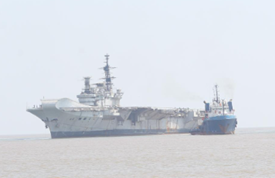 The recycling of Ex-INS Viraat at Alang, Gujarat, stands as one of India’s most significant ship recycling projects. After serving the Indian Navy for 30 years and the Royal Navy for 27 years, the aircraft carrier was decommissioned in March 2017. It arrived at Alang for recycling in September 2020. Recognised by the Guinness World Records as one of the world’s longest-serving warships, Ex-INS Viraat symbolised decades of distinguished naval service. Its final journey showcased India’s growing capabilities in environmentally responsible ship recycling.The vessel logged more than 22,622 flying hours during its service. It spent 2,252 days at sea and sailed over 5.88 lakh nautical miles (10.94 lakh kilometres). Recycling such a large and complex vessel highlights India’s ability to recover valuable materials safely. It also reflects the country’s evolving environmental and occupational safety standards, supporting employment and economic activity. The recycling of Ex-INS Viraat at Alang, Gujarat, stands as one of India’s most significant ship recycling projects. After serving the Indian Navy for 30 years and the Royal Navy for 27 years, the aircraft carrier was decommissioned in March 2017. It arrived at Alang for recycling in September 2020. Recognised by the Guinness World Records as one of the world’s longest-serving warships, Ex-INS Viraat symbolised decades of distinguished naval service. Its final journey showcased India’s growing capabilities in environmentally responsible ship recycling.The vessel logged more than 22,622 flying hours during its service. It spent 2,252 days at sea and sailed over 5.88 lakh nautical miles (10.94 lakh kilometres). Recycling such a large and complex vessel highlights India’s ability to recover valuable materials safely. It also reflects the country’s evolving environmental and occupational safety standards, supporting employment and economic activity. |
Strengthening a Responsible Recycling Ecosystem
Ship recycling in India has evolved into a modern, regulated, and internationally aligned industry. The sector contributes to resource security, economic growth, employment generation, and environmental sustainability. Through sustained infrastructure upgrades and reforms, India has strengthened the safety and competitiveness of its ship recycling ecosystem. India’s emergence as the world’s leading ship recycling nation in 2025 reflects the success of these efforts. The increase in market share and recycling volume demonstrates the expanding capacity and competitiveness of Indian ship recycling yards. The achievement also underscores the effectiveness of the policy measures undertaken under Maritime India Vision 2030. As ship recycling continues to evolve, India is well positioned to remain a credible destination for ship recycling.
References
Ministry of Ports, Shipping and Waterways
https://dgma.gov.in/engineering-wing/ew-ship-recycling-in-india
https://shipmin.gov.in/sites/default/files/Annual%20Report%202024-25%20-%20English.pdf
https://shipmin.gov.in/sites/default/files/Annual%20Report%202025-26%20english.pdf
https://www.pib.gov.in/PressReleasePage.aspx?PRID=2098573®=48&lang=2
https://www.pib.gov.in/PressReleasePage.aspx?PRID=2280098®=3&lang=1
https://www.pib.gov.in/PressReleasePage.aspx?PRID=2276739®=3&lang=1
https://www.pib.gov.in/PressReleasePage.aspx?PRID=1659960&lang=2
Ministry of Defence
https://www.pib.gov.in/PressReleasePage.aspx?PRID=1483700&lang=2